In leather goods, the small parts decide whether a bag feels finished or falls apart after a season. So why choose an Aluminum Rivet Button Nail for leather goods? At Ruihexuan, we have spent years in clothing accessories and the machinery behind them, and aluminum is the material we keep coming back to when a project calls for a light, clean-looking fastener that will not fight the leather. This article explains how we think about the choice — from material behaviour to the details a buyer should confirm before placing an order.
The Short Answer: Why We Reach for Aluminum
Three reasons, in the order we usually give them. First, weight: an Aluminum Rivet Button Nail is noticeably lighter than brass or steel, which matters on a handbag that already carries hardware. Second, corrosion: aluminum forms a thin oxide layer instead of red rust, so it is far less likely to stain pale leather. Third, cost: for volume programmes it lets a buyer keep the look clean without paying for a premium metal.
None of that makes aluminum universally right. We still steer some customers to stainless or brass when the job is heavy, wet or decorative in a traditional way. But for everyday leather goods — bags, wallets, straps and trim — this is the option we test first.
What Leather Goods Ask of a Fastener
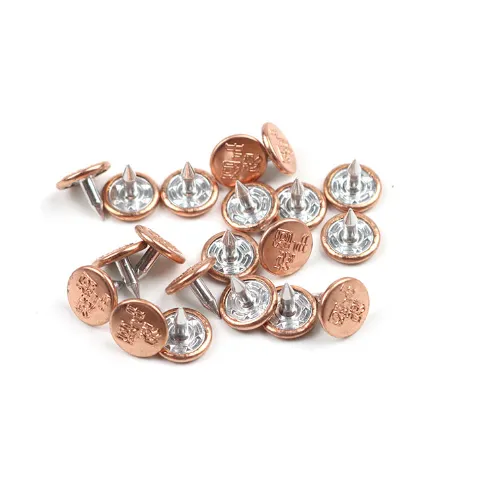
Leather is not fabric. It is thick, it compresses unevenly, and it does not forgive a fastener that concentrates load in one small spot. A rivet button nail has to hold through the stack, stay flat against the surface, and keep its finish when the material flexes. That is why we look at the assembly before we look at the price.
In our luggage and bag hardware work, the recurring mistake is choosing a head shape for the look and ignoring the back part. The visible face gets the attention, but the back part is what actually holds. We will ask about both.
Aluminum, Brass or Steel: The Call We Make
We get this question in almost every first enquiry. The honest answer is that each metal has a job. Here is the comparison we walk customers through when they are choosing an Aluminum Rivet Button Nail against the alternatives.
| Factor | Aluminum | Brass | Stainless steel |
|---|---|---|---|
| Weight | Lightest of the three | Heavier, more substantial | Similar to brass, slightly lighter |
| Corrosion behaviour | Thin oxide layer, no red rust | Can develop a patina over time | Strong rust resistance |
| Typical appearance | Pale, clean, easy to colour | Warm, traditional | Cool, industrial |
| Cost position | Usually the most economical | Mid to higher | Higher |
| Where we recommend it | Light leather goods, volume lines | Premium or classic hardware | Wet, high-wear or marine use |
You can also see our related aluminum rivet nails and the broader metal rivet category if you want to compare forms rather than metals.
The Specification Checklist We Work Through
We deliberately do not publish a single fixed size list. Leather stacks vary so widely that a catalogue number without context is more likely to mislead than help. Instead, we work through this checklist with every buyer.
| What we confirm | Why it matters | What we need from you |
|---|---|---|
| Head style | Decides the look on the visible face | A sample, photo or drawing |
| Shank diameter and length | Controls the grip through layered leather | Compressed stack thickness |
| Finish and colour | Must match the rest of your hardware | Pantone reference or a physical sample |
| Back part | Affects how the nail is set and how long it holds | Your assembly method |
| Quantity and packing | Drives the unit price and lead time | Per-order and annual volume |
| Market compliance | Some destinations restrict nickel or require documentation | Destination country |
Our full aluminum button nail range is organised around these choices, which is why we would rather talk through your application before quoting a number.
Where It Fits in Leather Work
We would rather tell you where a fastener is weak than find out after delivery. This is the matching table we keep beside us when a customer describes a product.
| Application | Fit | Our reasoning |
|---|---|---|
| Handbags and small leather goods | Best fit | Light weight, clean face, low rust-stain risk |
| Wallets and card holders | Good | A low-profile head keeps the silhouette neat |
| Belts and straps | Good, with the right back part | Needs to tolerate flex rather than just static load |
| Leather trim on garments | Good | Easy to match with other clothing metal accessories |
| Heavy saddlery or equestrian gear | Ask us first | May need a stronger metal than aluminum |
| Leather exposed to salt water | Not our first pick | Consider stainless steel for this environment |
For denim and garment applications, we often point buyers toward our aluminum jeans button nail instead — similar material logic, different head and setting method.
Finish and Colour Are Not Cosmetic
On leather, a finish has to survive handling. A coating that looks fine on a sample card can scuff at the edges of a bag pocket after a few weeks. We pay attention to how a finish is applied, not just how it looks on day one, and we will tell you when a requested colour is likely to wear unevenly.
We have written about fastening hardware with a clean finish before, including double-sided rivets, and the same principle applies here. If you are matching an existing hardware family, send that piece to us — a physical sample removes most of the guesswork.
Why Buying Direct From the Manufacturer Matters
Zhejiang Ruihexuan Import and Export Co., Ltd. is a large-scale Aluminum rivet Button Nail manufacturer and supplier in China. We have been specialized in clothing accessories and the related machinery and equipment for many years, and our products carry a real price advantage across most Southeast Asian markets. That combination — accessories plus the machines that make them — is unusual, and it changes what we can tell you.
Because we understand the production side, we can say when a design will be difficult to set, or when a finish will need an extra step. You can read more on our about page, and our download area holds catalogue material if you want the broader picture before contacting us. We are looking for long-term partners, not one-off shipments.
How to Specify an Order Without Guesswork
The fastest enquiry is a boring one. Tell us the application, the compressed material thickness, the quantity range and whether you need a logo or a specific colour. If you have a sample, send it. If you have a drawing, send that too. We will come back with a recommendation rather than a price list with fourteen options.
It also helps to say which market you are selling into, because compliance requirements change what we can supply. Our metal button nails overview and our riveting equipment page give useful context if you are setting up production rather than just buying parts.
Frequently Asked Questions
1. Why use an aluminum rivet button nail for leather goods rather than brass?
Aluminum is lighter, does not develop red rust and normally costs less than brass. For handbags and small leather goods where weight and a clean pale finish matter, we usually recommend it first. Brass still wins when a warmer, more traditional look is the priority.
2. Is an aluminum rivet button nail strong enough for a handbag?
It depends on the shank diameter and the back part, not on the name of the material alone. We size it against the thickness of the leather stack and the load on that point. Send us a sample or a drawing and we will confirm rather than guess.
3. Can Ruihexuan customize the finish or add a logo?
Yes. We work in clothing accessories and the related machinery, so finish, colour and branding are part of our daily work. Tell us the hardware family you are matching and we will propose a finish route before production.
4. What sizes of aluminum rivet button nail can I order?
We do not publish a single fixed size list because leather stacks vary so much. Give us the measured thickness of your material and the look you want on the visible face, and we will match a shank and head to it. A physical sample is always the fastest route.
5. Will aluminum rust or discolor leather?
Aluminum forms a thin oxide layer rather than red rust, which is one reason we like it for light-coloured leather. If your market has nickel restrictions, say so at enquiry stage and we will confirm the finish and composition with you.
6. How do I get a quote or a sample from Ruihexuan?
Send the application, your quantity range and either a sample or a drawing through our contact page. We reply within 24 hours and can point you to our downloadable catalogue while you wait.
Talk to Our Team
Still deciding which fastener fits your leather goods?
Tell us the product, the material thickness and the look you are after. We will confirm whether the Aluminum Rivet Button Nail is the right choice, or point you to a better option. You can contact our team or leave a message, and we will get back to you within 24 hours.